
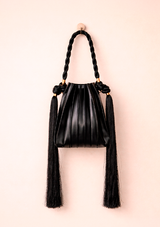
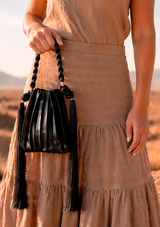
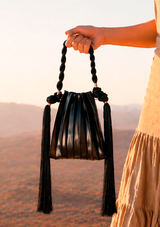


Black Silk Tassel Bag
She Carries Everything. She Shows Nothing.
The Black Silk Tassel Bag is where couture meets craft. A structured black PU leather pleated bucket bag — architectural in its folds, deliberate in its lines — carried by a braided silk handle and anchored by dramatic silk tassels, finished with golden copper wire details that tie the entire Flor Negra collection together.
This bag does not follow trends. It sets them.
The pleats speak of precision. The tassels speak of freedom. Together they speak of a woman who holds both — structure and movement, control and expression — in perfect balance.
Every detail is handcrafted by artisan women in El Salvador. The silk is real. The intention is deeper.
Black PU leather pleated bucket bag, Braided silk handle, Dramatic silk tassel details, Copper wire gold accents, Handcrafted by Salvadoran artisans, Fair trade certified · Eco-friendly. Made in El Salvador
Part of the Flor Negra Mother's Day 2026 Collection by Lula Mena.

INCOME

 The norm in rural areas is that children between the ages of 10 to 12 work the fields with their parents taking care of crops.
SCHOOLING


58% of the people that live in rural areas in El Salvador live in overcrowded conditions. When there is overcrowding in families, there is a higher risk of certain problems occurring, such as domestic violence, family disintegration, poor school performance, among others.

300 SALVADORANS TRY TO MIGRATE TO THE UNITED STATES DAILY DUE TO LACK OF WORK OPPORTUNITIES.
When Lula Mena began working in rural communities, many of the young women wanted to immigrate to the United States. Now that they have seen that there is an opportunity for a better life in their community, their perception of immigration has changed. They feel more confident that they will be able to provide for their families without having to leave the country. We want to continue to grow in order to offer more young adults the opportunity to work with us and avoid immigration.

One of the major challenges we faced when we began working with women was gaining the approval of their husbands. Most of the husbands and family members worried that the women would not be able to work and meet the household’s responsibilities.
Now, their husbands prepare dinner, take care of the children, and offer them support. There is still a strong sexist culture, “machismo”, in rural areas of El Salvador that we are trying to change by empowering women.